
Hex Reverse · How It Plays · Guide
Hex Reverse Gameplay — Hex Grid Battles, Card Flipping and SP Skills
Hex Reverse gameplay explained from the store listing: the 19-space board, six-value cards, edge flips, run deck growth, SP skills and between-run upgrades.
By the Gamebase team · Updated 2026-10-08
On this page (12)
- The core loop in one pass
- Reading the 19-space board
- Building the deck as the run unfolds
- SP, elements and special battle conditions
- Between runs: base, fusion and equipment
- What the listing does not document
- How big is the battlefield in Hex Reverse?
- How does a card flip work?
- How do you get new cards during a run?
- What is SP used for?
- Is there anything to do between runs?
- How many cards or elements are in the game?
Hex Reverse gameplay runs on two layers that the store listing states outright: strategic territory-control card battles on a hexagonal grid, and roguelike deckbuilding progression. Each battle is fought on a field of 19 hexagonal spaces where you and your opponent alternate placing cards, and each card carries six values, one for every side. Placing a card next to an opponent’s card compares the touching edges, and if your value is higher that card flips to your side.
The core loop in one pass
The loop as the long description lays it out runs from placing cards to claiming territory, then to rebuilding the deck, then out to the base between runs.
| Step | What the store text says happens |
|---|---|
| Battlefield | a field of 19 hexagonal spaces |
| Turn order | you and your opponent take turns placing cards |
| Card data | six values per card, one for each side |
| Flip rule | touching edges are compared; the higher value flips the opposing card |
| Battle reward | choose one card from a selection taken from your opponent’s deck |
| Deck effect | the chosen card joins the current run deck and can be used in battles ahead |
| Skill resource | SP, spent on skills that change the state of the board |
| Between runs | base, saved decks, buying and selling, fusion, equipment upgrades |
| Escalation | increasingly difficult Rifts |
Two rows in that table are the whole game in miniature: the flip rule decides who owns the board, and the after-battle pick decides what you can do next time.
Reading the 19-space board
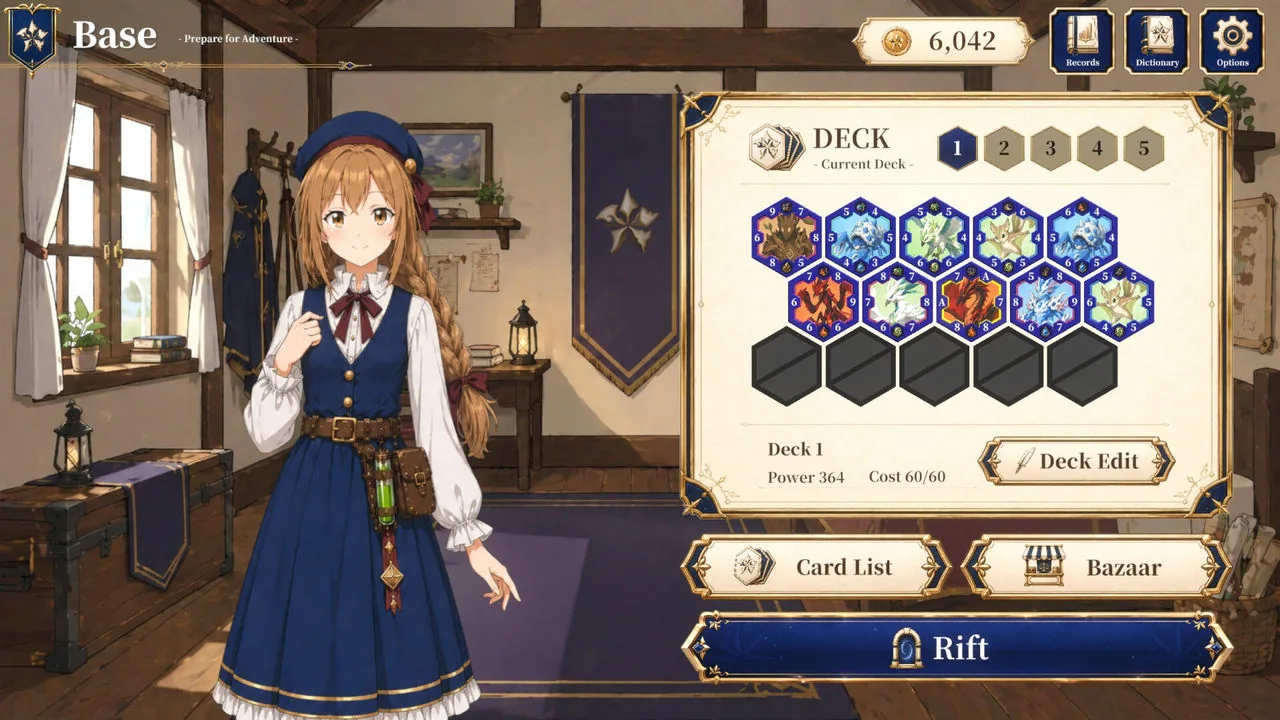
The published advice is to choose your position carefully, read the board, and use each card’s strengths to take control of as much territory as possible. Because only the touching edges are compared, where a card goes matters as much as which card it is, and the same card can be a strong play in one corner and a wasted turn in another. Nothing in the listing suggests a fixed opening, and no board layout, tile value or placement rule is described.
Building the deck as the run unfolds
Every run is a series of battles rather than one match. Win a battle and the game offers a selection of cards taken from your opponent’s deck; you pick one, and it goes directly into the deck you are currently playing with. The listing’s own summary is that every choice changes the shape of your deck, which is what lets a run adapt as the fights get harder.
SP, elements and special battle conditions
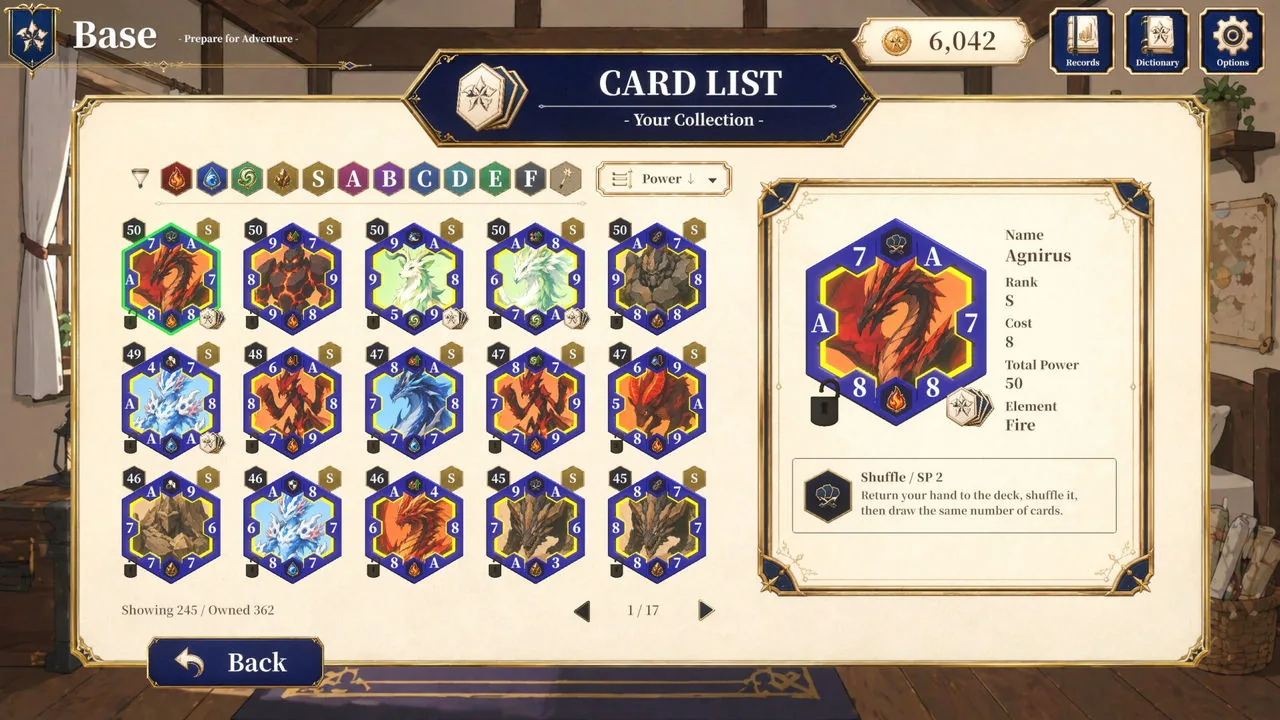
Cards are defined by more than their six values, and SP is the resource that expresses the difference.
- Strengthen cards you already control.
- Change a card’s element.
- Weaken opposing cards.
- Draw additional cards.
- Alter the flow of the battle.
Special rules and unique field conditions sit on top of that, and the listing says they can change how each battle plays out, forcing you to rethink familiar strategies and make the most of the cards available to you.
Between runs: base, fusion and equipment
When a run ends you return to your base to prepare for the next expedition. The named activities there are refining saved decks, buying and selling cards, fusing cards into stronger ones, and upgrading equipment that provides permanent progression. The stated goal is to strengthen your collection, improve your setup, and take on increasingly difficult Rifts.
That is an entire meta layer described in a single paragraph. It is the part of Hex Reverse most likely to decide how long you keep playing, and it is also the part with the least published detail.
What the listing does not document
The store page publishes no card total, no element list, no SP economy, no battle count per run, no board size other than the 19 spaces used in battle, and no Rift count or difficulty tier list. It also says nothing about what happens to a run when you lose it, or whether a failed run returns anything to the base. Those are the open questions to watch as official information appears; the published facts are collected on the Cheat Sheet, and the starting advice sits in the Beginner Guide.
FAQ
How big is the battlefield in Hex Reverse?
Battles take place on a field of 19 hexagonal spaces, with both sides taking turns placing cards.
How does a card flip work?
Each card has six values, one per side; when two cards touch, the values on the touching edges are compared and the higher value flips the opposing card to your side.
How do you get new cards during a run?
After winning a battle you choose one card from a selection taken from your opponent’s deck, and it is added to your current run deck.
What is SP used for?
SP activates skills that strengthen cards, change a card’s element, weaken opponents, draw additional cards and alter the flow of battle.
Is there anything to do between runs?
Yes. The store text says you return to your base to refine saved decks, buy and sell cards, fuse cards into stronger ones and upgrade equipment for permanent progression.
How many cards or elements are in the game?
Not published. The store page gives no card total, no element list and no number of battles per run.
References
- Steam store page — Hex Reverse
- Steam appdetails API (cc=us, l=en) — Hex Reverse
- Steam news hub — app 5257350
Facts on this page are compiled from the references above. Items marked "to confirm" are single-source and not yet verified.