
Hex Reverse · New Player Guide · Guide
Hex Reverse Beginner Guide — The Free Launch Window and Your First Run
Hex Reverse beginner guide: how the 30-day Steam free claim works, what a first run asks of you on the 19-hex board, and the systems the store page confirms.
By the Gamebase team · Updated 2026-10-08
On this page (12)
- What kind of game Hex Reverse is
- How the free launch window works
- What a first run looks like
- The systems layered on top of the board
- What happens between runs
- What the listing does not answer
- What kind of game is Hex Reverse?
- When was Hex Reverse released?
- How much does Hex Reverse cost?
- Do I keep the game if I claim it during the free period?
- How big is the battle board?
- How does a run get stronger?
Hex Reverse is a roguelike deckbuilding card game from IsaoWorks that launched on Steam on Oct 7, 2026, and it is free to claim during the first 30 days after release. Battles play out on a field of 19 hexagonal spaces, where you take turns placing cards, compare the values on touching edges, and flip enemy cards to your side when your value is higher. This beginner guide covers what the store listing confirms about a first session, and it marks the questions the listing leaves open instead of filling them in.
What kind of game Hex Reverse is
The store page describes Hex Reverse as a roguelike deckbuilding card game played on a hexagonal battlefield, and tags it Casual, Indie and Free To Play. The long description names its two halves directly: strategic territory-control card battles on a hexagonal grid, and roguelike deckbuilding progression. IsaoWorks is both the developer and the publisher, the listing publishes a Windows build only, and it lists English and Japanese support. There is no demo entry and no DLC entry on the record.
| Published fact | Value at the time of capture |
|---|---|
| Release date | Oct 7, 2026 |
| Developer and publisher | IsaoWorks |
| Platform | Windows |
| Genres | Casual, Indie, Free To Play |
| Price at capture | none listed; free-to-play flag set |
| Free launch window | first 30 days after release |
| Languages | English and Japanese |
| Achievements | 27 |
| Screenshots and trailers | 8 and 1 |
Only one row in that table moves on its own: the price. The rest are properties of the listing as captured on 2026-10-08.
How the free launch window works
The Launch Pricing paragraph says the game will be available for free during the first 30 days after release. It adds that anyone who adds the game to their Steam library during that free period keeps permanent access even after it becomes a paid title. Once the window closes, the game transitions to paid availability with regional pricing applied through Steam.
What the same paragraph does not give is the exact date the window ends or a number for the paid price. Treat the window as a claim deadline rather than a trial: the listing ties the permanent copy to claiming the game, not to playing a set number of hours inside those 30 days.
What a first run looks like
The long description walks the loop in order, so the order below is the store text’s own.
- A run is described as a series of battles rather than a single match.
- Battles take place on a field of 19 hexagonal spaces, with you and your opponent taking turns placing cards.
- Every card carries six values, one for each side.
- Place a card next to an opponent’s card and the values on the touching edges are compared.
- If your value is higher, the opposing card flips to your side.
- After a win you choose one card from a selection taken from your opponent’s deck, and it is added to your current run deck.
- SP powers skills that strengthen cards, change their element, weaken opponents, draw additional cards and alter the flow of battle.
- Special rules and unique field conditions can change how a battle plays out.
The listing frames the skill ceiling as reading the board rather than memorising cards: choose your position carefully, read the board, and use each card’s strengths to take control of as much territory as possible.
The systems layered on top of the board
Cards are described as being defined by more than their six values, which is where SP, elements and special battle conditions come in. SP is spent to strengthen your own cards, to change a card’s element, to weaken opposing cards, to draw extra cards, or to alter the flow of a battle. Field conditions can rewrite the rules of an individual fight, which the listing presents as a reason to rethink a strategy that has been working.
What the listing does not explain is how SP is earned, whether it carries between battles, how many elements exist, or how often a special condition appears. Those are gaps, not details, and the store page answers none of them.
What happens between runs
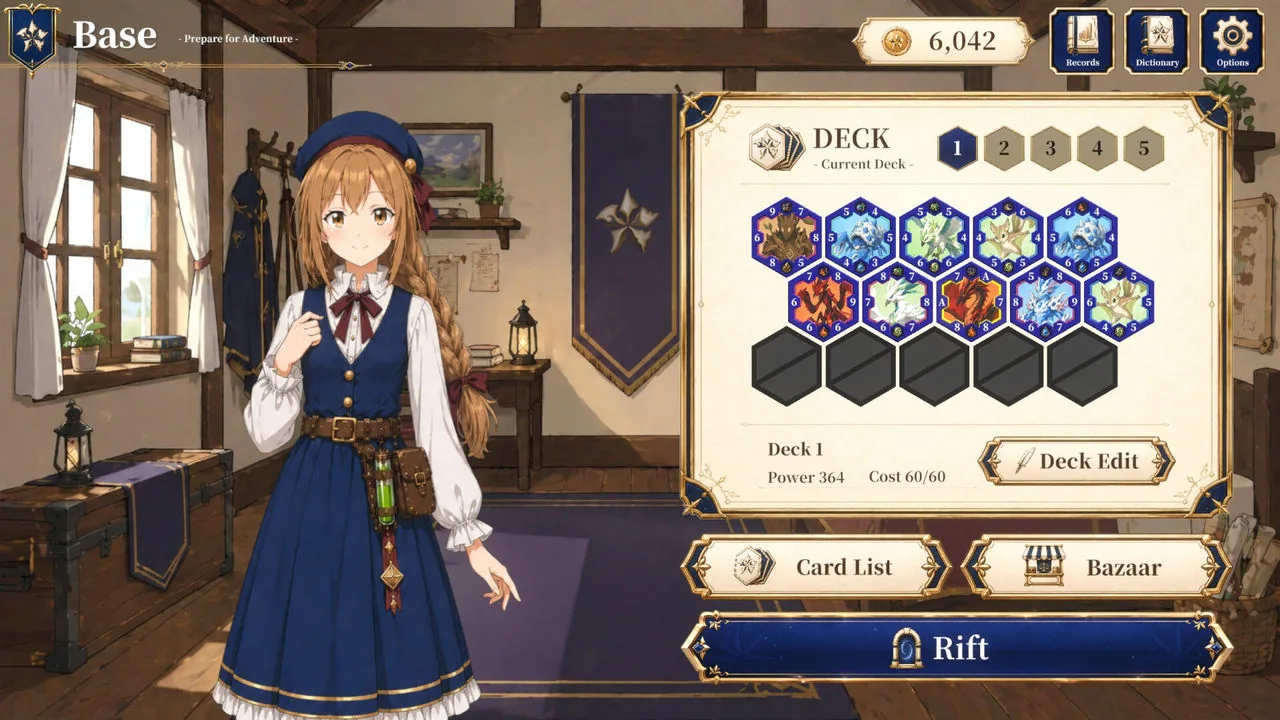
A run ending is not the end of progress. The listing says you return to your base to prepare for the next expedition, and it names four jobs there: build and refine your saved decks, buy and sell cards, fuse cards into stronger ones, and upgrade equipment that provides permanent progression. The stated point of that loop is to strengthen your collection and take on increasingly difficult Rifts.
No count is published for how many Rifts exist, how far the upgrade path runs, or what a finished run banks. The between-run systems get one paragraph on the store page and are detailed nowhere else on it.
What the listing does not answer
A beginner guide is only useful if it separates answered questions from open ones, so here is the open list for Hex Reverse. The store page publishes no level or chapter count, no number of battles per run, no completion time, no difficulty tiers and no card total, and the only board size it names is the 19 hexagonal spaces used in battle. It also publishes no full achievement list and no unlock conditions, and there is no official site to check against, because the app details record has no website field.
To go deeper on the rules themselves, continue with How It Plays. For availability and the store entry, see Availability, and for the launch terms in table form, see the Cheat Sheet.
FAQ
What kind of game is Hex Reverse?
A roguelike deckbuilding card game played on a hexagonal battlefield, listed under Casual, Indie and Free To Play.
When was Hex Reverse released?
The Steam store page lists Oct 7, 2026 as the release date.
How much does Hex Reverse cost?
At capture the listing showed no price and carried the free-to-play flag; the store text says the game is free during the first 30 days after release.
Do I keep the game if I claim it during the free period?
Yes. The store text says that adding it to your Steam library during the free period keeps permanent access after it becomes a paid title.
How big is the battle board?
Battles are played on a field of 19 hexagonal spaces, with you and your opponent taking turns placing cards.
How does a run get stronger?
After winning a battle you choose one card from a selection taken from your opponent’s deck, and it joins your current run deck.
References
- Steam store page — Hex Reverse
- Steam appdetails API (cc=us, l=en) — Hex Reverse
- Steam news hub — app 5257350
Facts on this page are compiled from the references above. Items marked "to confirm" are single-source and not yet verified.