
The Crimson Hunt · How It Plays · Guide
The Crimson Hunt Gameplay — Third-Person Combat, Resources and Local Co-op
How The Crimson Hunt plays: third-person combat, weapons and tools, resource management, environment-driven puzzles and local split-screen co-op.
By the Gamebase team · Updated 2026-10-08
On this page (11)
- The loop in one table
- Third-person combat and enemy pressure
- Weapons, tools and resource management
- Environment-driven puzzles and light
- Local split-screen co-op
- What gameplay details are not published
- What perspective is The Crimson Hunt played from?
- Is ammunition limited?
- What kinds of puzzles does the game have?
- How does co-op work?
- Can The Crimson Hunt be played solo?
The Crimson Hunt plays as a modernized classic survival horror: third-person combat with weapons and tools, limited ammunition, sparse healing, environmental and mechanical puzzles, and a second player available in local split-screen co-op. Every element below is taken from the store listing rather than from play testing.
The loop in one table
| Element | What the listing says |
|---|---|
| Perspective | Third-person combat |
| Combat | Grotesque creatures, unpredictable enemies, strategy and positioning |
| Weapons and tools | Combine a variety of weapons and tools to adapt |
| Resources | Ammunition limited, healing scarce, every item counts |
| Light | Described as vital |
| Puzzles | Environmental and mechanical, solved by observation, logic and exploration |
| Environments | Dark and oppressive, decaying corridors, danger around every corner |
| Co-op | Local split-screen, the full journey with another player |
| Narrative | Character-driven, built on the relationship between the two leads |
The table is a summary of listing language, not a systems document, so no numeric values are published for damage, enemy health, inventory slots or ammunition capacity.
Third-person combat and enemy pressure
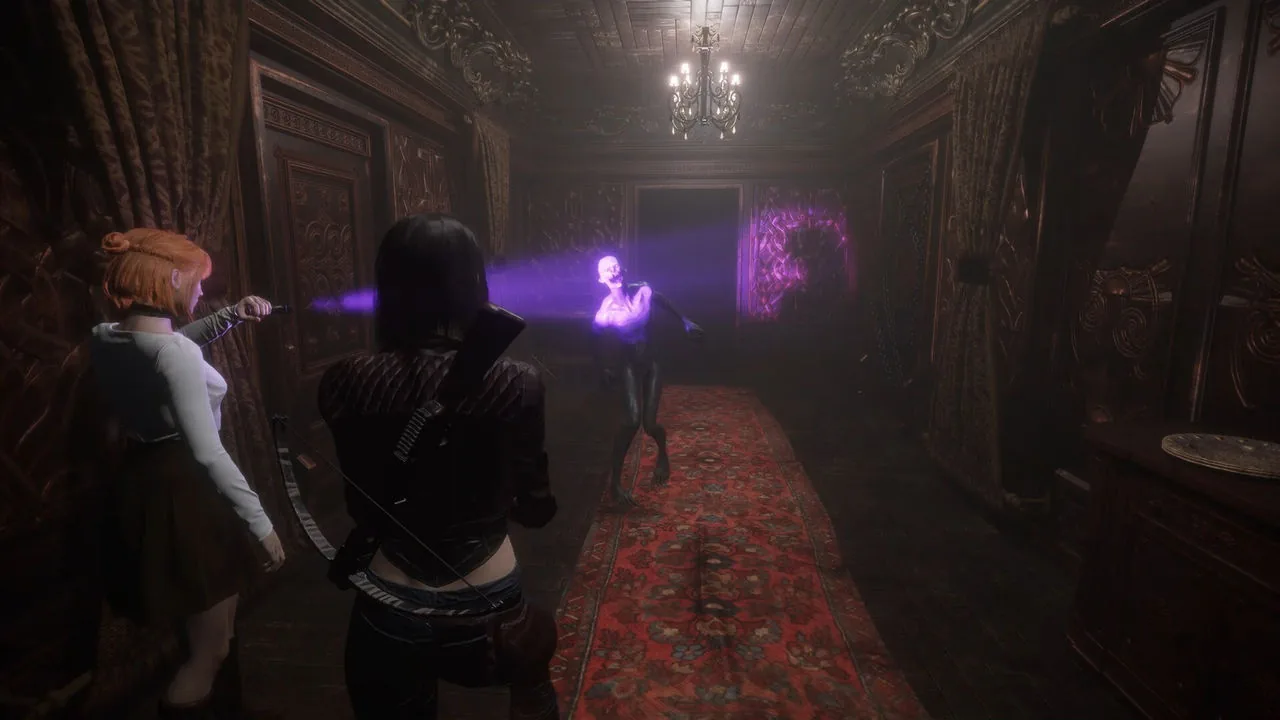
Combat is the most quoted system on the page. The listing says encounters demand strategy, positioning and steady nerves, and it calls the enemies grotesque creatures rather than naming a roster. The synopsis adds vampires, ghouls and bloodthirsty creatures, and the short description mentions hidden traps.
Two things follow from that wording. Positioning is treated as a skill the game expects rather than an optional extra, and because every encounter matters, avoiding a fight is presented as a legitimate answer rather than a failure.

Weapons, tools and resource management
The listing groups weapons and tools into one system: combine a variety of weapons and tools to adapt to unpredictable enemies. It never separates the two, and it publishes no weapon names.
- Ammunition is limited, not infinite.
- Healing is scarce rather than purchasable.
- Every item counts, so hoarding and discarding both carry a cost.
- Light is vital, which makes light sources a resource in their own right.
- Smart inventory management is described as the difference between life and death.
- Enemies are unpredictable, so no single loadout is promised as a solution.
Environment-driven puzzles and light
Progression is gated by environment-driven puzzles: environmental and mechanical problems that the listing says are solved through observation, logic and exploration. The synopsis calls the same idea ancient mechanisms, set inside decaying corridors.
Light is named before weapons on the store page, which is the clearest signal about tone. Darkness is a working part of the design, and the listing treats visibility as something the player manages rather than something the game guarantees.
Local split-screen co-op
Co-op is local and split-screen. The feature text says the full journey is playable with another player, that both players coordinate strategies, share resources and face the horror as a team. The category list backs that up with Multi-player, Co-op, Shared/Split Screen Co-op and Shared/Split Screen, plus Remote Play Together and Family Sharing.
The listing does not say how many copies are required, whether progress is shared, or whether either player can drop in mid-run. Those are not published.
What gameplay details are not published
The store page publishes no control scheme, no weapon or tool list, no enemy or boss count, no difficulty tiers, no death penalty, no checkpoint or save details, no chapter count and no completion time. It also does not describe how solo play differs from split-screen play.
The same facts restated as a lookup sheet are on the cheat sheet; the opening session is walked through on the beginner guide, and the machine requirements for running it are on system requirements.
FAQ
What perspective is The Crimson Hunt played from?
Third person. The listing carries a Third-Person Combat feature and frames encounters around strategy, positioning and steady nerves.
Is ammunition limited?
Yes. The store text says ammunition is limited and scarce, healing is scarce, and every item counts, so inventory management is part of survival.
What kinds of puzzles does the game have?
Environmental and mechanical puzzles. The listing says observation, logic and exploration are essential, and the synopsis mentions ancient mechanisms.
How does co-op work?
Local split-screen co-op is a listed feature: two players coordinate strategies, share resources and face the horror as a team, and the whole journey is described as playable that way.
Can The Crimson Hunt be played solo?
Yes. Single-player is listed alongside Multi-player and Co-op, though the store page does not describe how the solo flow differs from the co-op flow.
References
- Steam store page — The Crimson Hunt
- Steam appdetails API (cc=us, l=en) — The Crimson Hunt
- Steam news hub — app 4485020
Facts on this page are compiled from the references above. Items marked "to confirm" are single-source and not yet verified.