
Olympus 2249 · How It Plays · Guide
Olympus 2249 Gameplay - Turn-Based Combat, Hazards and the Peaceful Route
Olympus 2249 gameplay from the store copy: turn-based combat, positioning, battlefield hazards, Stamina abilities, Karmic Type and the peaceful route.
By the Gamebase team · Updated 2026-10-08
On this page (12)
- The combat loop in one pass
- Positioning, hazards and aimed shots
- Stamina, abilities and how failure is handled
- Karmic Type changes the run, not just the dialogue
- Five peaceful specializations and the systems toolbox
- What the store copy does not document
- Is Olympus 2249 combat real-time or turn-based?
- What can you do with the environment in a fight?
- What does Stamina do?
- Can you avoid combat entirely?
- Is there a death penalty or a limited-save system?
- How many quests or enemies are in the Early Access build?
Olympus 2249 plays as a turn-based cRPG in an isometric view, and its store copy describes combat as a puzzle with more than one correct solution rather than a damage race. The loop is: position your character, use the battlefield, spend Stamina on abilities, and pick your target. The same listing also documents a full non-combat route through five peaceful specializations.
The combat loop in one pass
Every mechanic below is transcribed from the store page, and each one is named in a single sentence of that copy. Nothing is added from play footage or third-party summaries.
| Combat element | What the store copy says |
|---|---|
| Format | Combat is turn-based, and you are told to take your time |
| Opening step | Position yourself before anything else |
| Fuel barrels | Kick one toward an enemy and blow it up |
| Oil spills | Set them ablaze |
| Electricity and traps | Use them and whatever else the battlefield hands you |
| Aimed shots | Aim for arms, legs, or the head |
| Stamina | Spend it on special combat abilities |
| Design intent | Hard fights are puzzles with more than one correct solution |
That table is the whole published combat system. The listing does not describe turn order, movement ranges, action points or damage formulas, so no numbers can be attached to any of these rows.
Positioning, hazards and aimed shots
Positioning is listed as the first action, ahead of any attack, which fits a design where the environment does the work. A fuel barrel is an object you kick toward an enemy before detonating it, and an oil spill is a surface you set on fire. Electricity and traps are described as part of whatever the battlefield hands you, which suggests per-encounter tools rather than a fixed loadout.
Aimed shots are explicitly split into arms, legs and the head. The listing never says what each location does, so the effect of a limb hit is not documented. What is documented elsewhere on the page is that dismemberment exists as a system, and the content note warns about visible injuries and dismemberment.
Stamina, abilities and how failure is handled
Stamina is the named combat resource, and it is spent on special combat abilities. No maximum, regeneration rule or per-ability cost is published anywhere in the listing, so the only safe statement is that the resource exists and that abilities consume it.
Failure handling is lighter on detail. The feature list includes Save Anytime, Adjustable Difficulty, Playable without Timed Input and playable at your own pace, but the store page publishes no death penalty, no ironman mode and no retry rule. Hard fights being puzzles with more than one correct solution is the closest thing to a design statement about losing.
Karmic Type changes the run, not just the dialogue
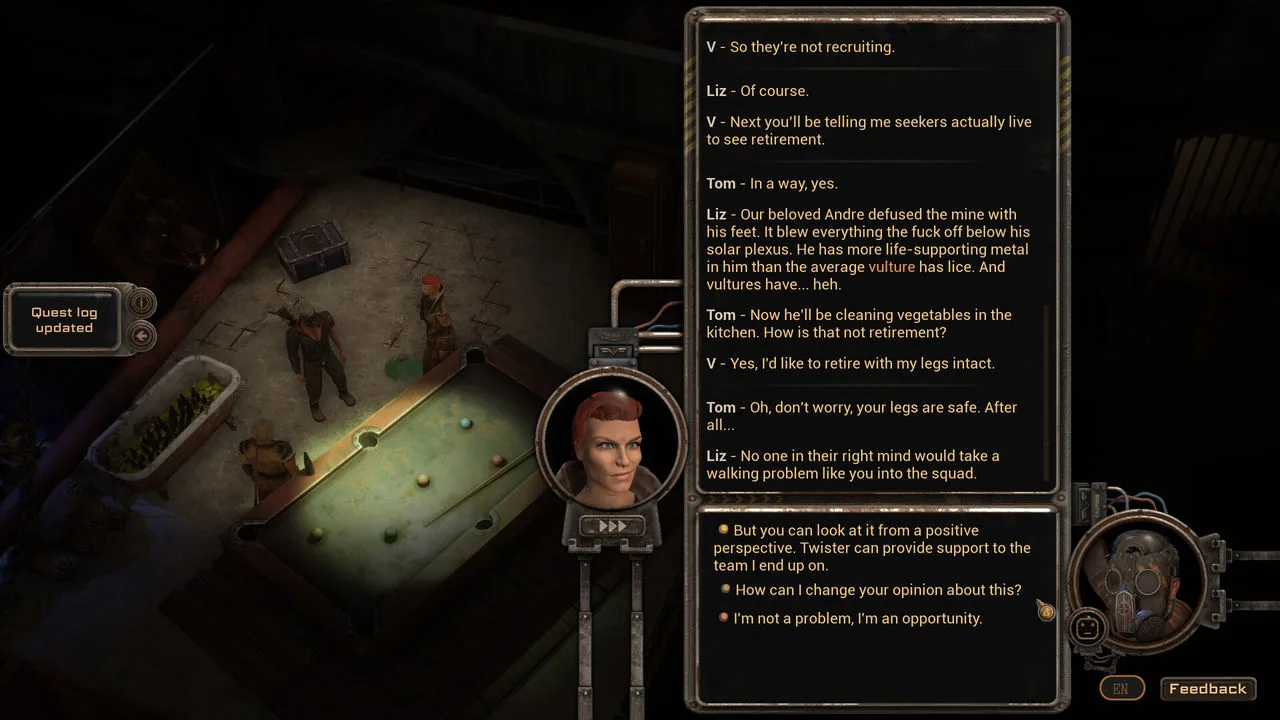
Your Karmic Type is one of five and shapes the entire playthrough. The copy says you begin as a Moralist, an Asshole, or somewhere in between, and that people react to you differently, while dialogues, quests and opportunities change. Karma shifts with your choices, and the listing notes that the character who starts the story does not have to be the one who finishes it.
The consequences are concrete. A faction that will not take you in and a quest you will never be offered are the two examples the page gives. Because those are route-level losses, a Karmic Type choice is effectively a content filter rather than a dialogue flavour, and one run cannot cover the whole game.
Five peaceful specializations and the systems toolbox
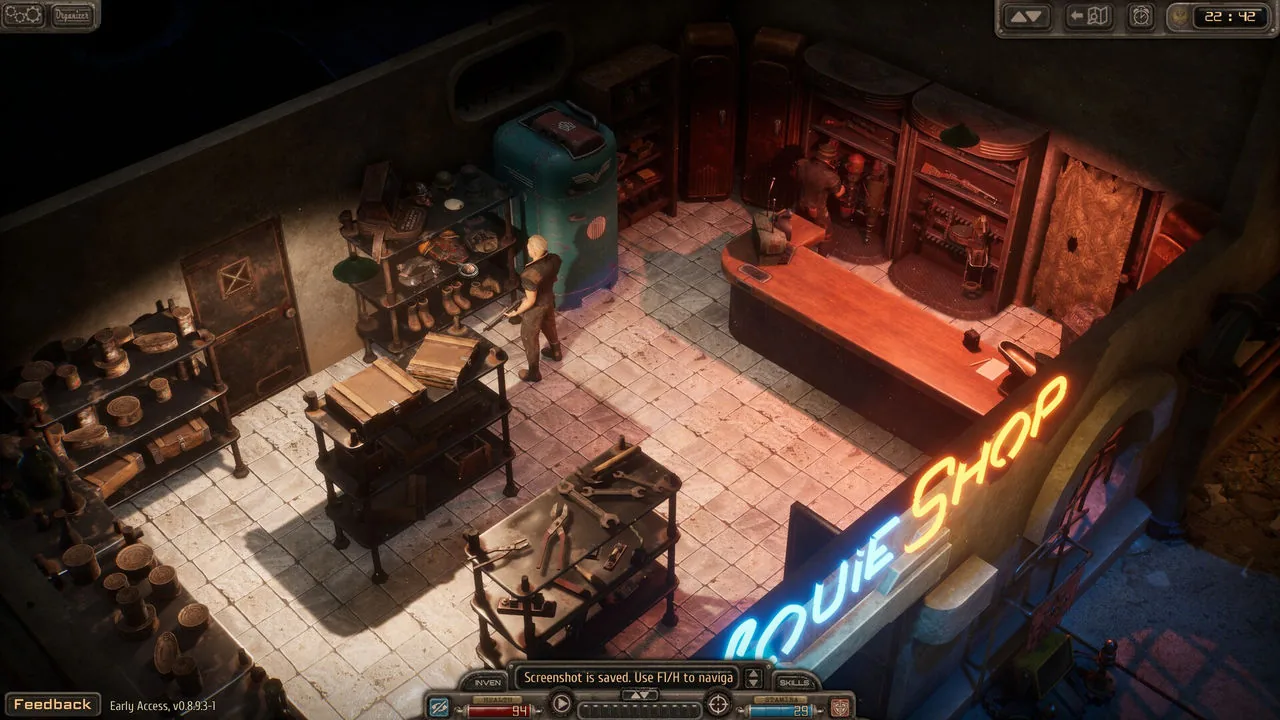
Five peaceful specializations are available, and each one unlocks new dialogue options and new ways to solve problems. Quests are described as built around using those skills and systems rather than around killing people, and even the simplest fetch quest is framed as a small adventure.
The Early Access build is said to already include this full toolbox:
- Crafting, for building and improving gear.
- Stealth, as an approach alongside direct combat.
- Desert storms that reshape the gameplay while they last.
- Hazardous environments such as radiation and poison zones.
- A day and night cycle, with NPCs keeping their own daily routines and their own beds.
- An armor system.
- Dismemberment, also flagged in the content note.
- Procedural enemy and loot generation for random encounters and raids.
That list is broader than the combat section alone, and the Early Access answers say all mechanics are already implemented and balanced for different playstyles. The balance of the RPG, combat and economy systems is what the developers say Early Access is for.
What the store copy does not document
The gaps are large and worth naming: no level curve or XP values, no death or reload penalty, no party size, no skill tree entries, no Stamina cap, no battle map count, no enemy count, no difficulty tier names and no ending count. The user tags include Multiple Endings, but the copy never states how many endings exist or how they are reached.
One scope figure does exist. The Early Access answers say the build holds about a quarter of the story, that a playthrough takes around 3 to 7 hours depending on build, playstyle and side quests, and that the first of three planned story acts is included.
The opening decisions are covered on the Beginner Guide, the same systems are expanded feature by feature on Features, and the published achievement names are listed on Achievements.
FAQ
Is Olympus 2249 combat real-time or turn-based?
Turn-based. The store copy says combat is turn-based and tells you to take your time, with positioning as the first step.
What can you do with the environment in a fight?
The copy names fuel barrels that can be kicked toward an enemy and blown up, oil spills that can be set ablaze, and electricity and traps.
What does Stamina do?
Stamina is spent on special combat abilities, according to the store copy. No Stamina cap or per-ability cost is published.
Can you avoid combat entirely?
The short description says problems can be solved without firing a shot, and five peaceful specializations unlock new dialogue options and new ways to solve problems.
Is there a death penalty or a limited-save system?
Not documented. The listing only lists Save Anytime and Adjustable Difficulty as features, and says nothing about death penalties.
How many quests or enemies are in the Early Access build?
Not published. The store page gives no quest count, enemy count or map count for the Early Access build.
References
- Steam store page — Olympus 2249
- Steam appdetails API (cc=us, l=en) — Olympus 2249
- Steam news hub — app 5094490
Facts on this page are compiled from the references above. Items marked "to confirm" are single-source and not yet verified.